Launch of the Africa CDC toolkit for hepatitis B: bringing care closer to people in Africa
The Africa Centres for Disease Control and Prevention (CDC), together with the Hepatitis B in Africa Collaborative Network (HEPSANET), convened a group of experts in 2024 to develop a practical toolkit for decentralised hepatitis B management in Africa based on the 2024 WHO guidelines. The group included clinicians, researchers, patient advocates, and programme managers from Ministries of Health (appendix). Our aim was to provide healthcare workers with practical, easy-to-use guidance that remains applicable where diagnostic capacity is restricted. Hepatitis B elimination cannot be achieved through a centralised specialist model.
The toolkit has several innovations.10 First, it asks healthcare workers which tests are available in their setting and directs them to the corresponding management algorithm. At lower levels of care, where only point-of-care rapid tests may be available, healthcare workers can counsel patients, while also testing and vaccinating family members or other contacts of persons with hepatitis B, identify clinical warning signs, start treatment for people at high risk of disease progression, and refer when referral is likely to improve prognosis or symptom control. At higher levels of care where additional tests are available, the algorithms support more detailed assessment while keeping care close to where people live.
See the full commentary in the Lancet Gastro
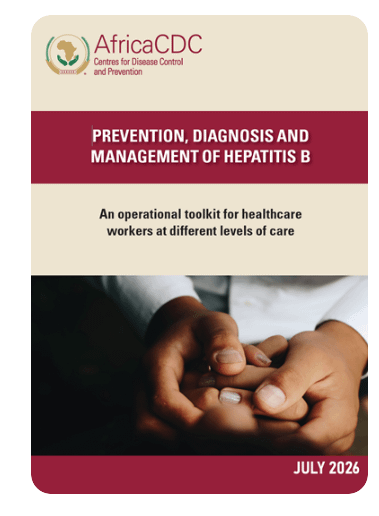
Prevention, Diagnosis and Management of Hepatitis B
The ABAC and Hepatitis B Foundation partnered with HEPSANET and Africa CDC to develop a practical toolkit for decentralised hepatitis B management in Africa based on the 2024 WHO guidelines. The group included clinicians, researchers, patient advocates, and programme managers from Ministries of Health from across Africa.
Our aim was to provide healthcare workers with practical, easy-to-use guidance that remains applicable at all levels of care, including rural and decentralised sites.
VIEW TOOLKITS with the Link below
Knowledge and Attitudes of Women in the Pre- and Postnatal Period on Screening and Mother-to-Child Transmission of the Hepatitis B Virus in Mali
Hepatitis B virus (HBV) infection remains a major public health problem in Mali, with an estimated prevalence ranging between 8% and 10%. Despite the integration of HBV vaccination into the Expanded Programme on Immunisation (EPI), coverage of the birth dose and community awareness remain low. This study aimed to assess the knowledge, attitudes, and practices (KAP) of women in the prenatal and postnatal periods regarding HBV screening and the prevention of mother-to-child transmission in Bamako. A qualitative exploratory study was conducted among sixteen (16) women aged 22 to 36 years who attended prenatal and postnatal consultations in two referral health centres in Bamako. Data were collected through focus group discussions and analysed using Braun and Clarke’s thematic analysis approach. Results demonstrated that participants had limited knowledge of HBV transmission and prevention. However, they expressed strong trust in healthcare personnel and a high willingness to accept screening, treatment, and neonatal vaccination if offered. The main barriers identified were a lack of health education, weak communication from healthcare providers, and the persistence of traditional beliefs. Despite poor awareness of HBV, the acceptability of preventive measures remains high. Strengthening health education, training healthcare workers, and systematically integrating the HBV birth dose into perinatal care are essential to reduce mother-to-child transmission in Mali.
READ MORE
Insights from strengthening perinatal hepatitis b prevention in healthcare facilities in Delta State, Nigeria: A prospective, pilot implementation intervention
Hepatitis B is a serious liver infection that affects millions of people around the world and is one of the leading causes of liver cancer and related deaths. One of the most common ways it spreads is from mother to child during childbirth. Babies who become infected at birth are at high risk of developing chronic hepatitis B, which can cause lifelong health problems. Although there is a highly effective vaccine that can prevent this, it must be given within 24 hours of birth. Unfortunately, in many parts of Nigeria, including Delta State, not all babies receive the vaccine on time due to issues like vaccine access, staff shortages, and limited awareness among healthcare workers and families. To address this, a project called StopHepB: Break the Cycle, Protect the Next Generation was carried out in five hospitals across Delta State from February to May 2025. The project aimed to stop the transmission of hepatitis B from mothers to their babies by screening all pregnant women for the virus during their first antenatal visit, linking those who tested positive to free antiviral treatment, and ensuring that every baby born in the hospital received the hepatitis B vaccine within 24 hours. A key part of the project’s success was moving the vaccine supply directly into labor wards, allowing nurses to vaccinate newborns immediately after delivery. Before the intervention, only about 6% of babies received the vaccine on time. After the project was implemented, timely vaccination coverage jumped to 100% in the five pilot hospitals, with most babies receiving the vaccine within just two and a half hours of birth. All mothers who tested positive for hepatitis B were linked to care, and their babies received the vaccine on time. This represents a major step forward in preventing mother-to-child transmission of the virus.
Read More Here
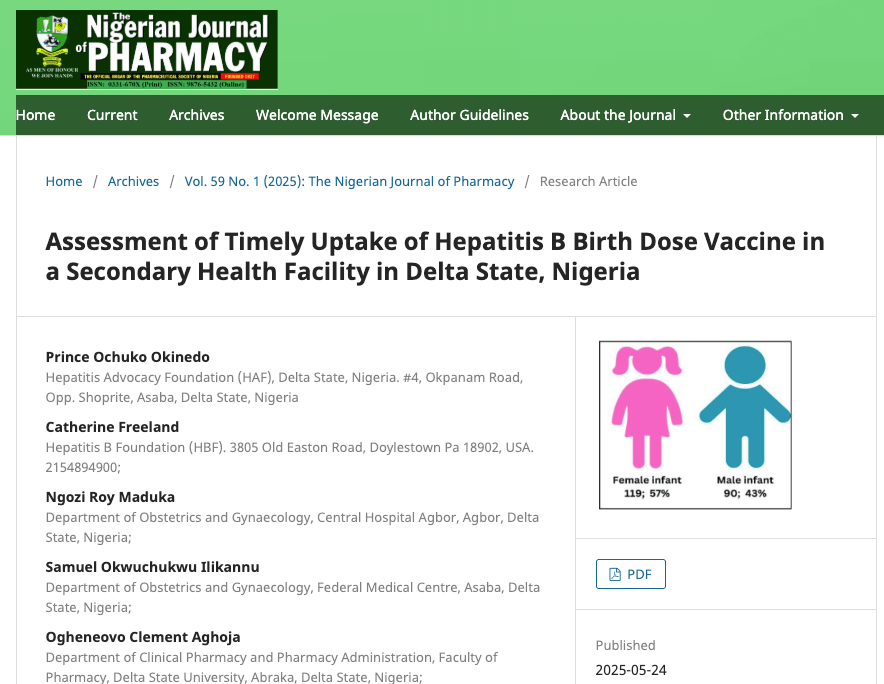
Assessment of Timely Uptake of Hepatitis B Birth Dose Vaccine in a Secondary Health Facility in Delta State, Nigeria
Objectives: To determine the percentage of timely HepB-BD vaccine uptake as well as the extent of HepB-BD deferment amongst newborns delivered in a secondary health facility. Materials and Methods: This study was a retrospective, non-invasive cohort assessment which deployed a convenience sampling technique to inspect child health cards of all infants brought to the antenatal clinic of Central Hospital Agbor, a secondary health facility in Delta State, Nigeria, for their routine vaccinations within a 4-week period in January 2024.
Results: 209 infants 43% male, 57% female, were assessed for HepB-BD. Only 12 infants received( ) the HepB-BD within the first 24 hours of life, while 197 received theirs after 24 hours. Timely HepB- BD uptake was found to be 5.7% within this health facility. Delays in the uptake of HepB-BD vaccine varied from 1 day (minimum) to up to 43 days (maximum) amidst absence of a clear HepB-BD policy in the facility. All 12 infants who received the timely HepB-BD vaccine were either born late on a Wednesday, or on a Thursday as matched on the calendar. A total of 15 infants out of 197 who received the HepB-BD vaccine, post-24 hours, were also observed to be born on a Thursday, but after 4pm.
Conclusion: Timely and deferred HepB-BD uptake in Central Hospital Agbor, Delta State were found to be 5.7% and 94.3% respectively. Effort is needed to further address barriers to HepB-BD timely coverage to prevent transmission from mother to child.
Evaluation of interventions to improve timely hepatitis B birth dose vaccination among infants and maternal tetanus vaccination among pregnant women in Nigeria
Background: Nigeria has the largest number of children infected with hepatitis B virus (HBV) globally and has not yet achieved maternal and neonatal tetanus elimination. In Nigeria,maternal tetanus diphtheria (Td) vaccination is part of antenatal care and hepatitis B birth dose (HepB-BD) vaccination for newborns has been offered since 2004. We implemented interventions targeting healthcare workers (HCWs), community volunteers, and pregnant women attending antenatal care with the goal of improving timely (within 24 hours) HepB-BD vaccination among newborns and Td vaccination coverage among pregnant women. Methods: We selected 80 public health facilities in Adamawa and Enugu states, with half intervention facilities and half control. Interventions included HCW and community volunteer trainings, engagement of pregnant women, and supportive supervision at facilities. Timely HepB-BD coverage and at least two doses of Td (Td2+) coverage were assessed at baseline before project implementation (January–June 2021) and at endline, one year after implementation (January–June 2022). We held focus group discussions at intervention facilities to discuss intervention strengths, challenges, and improvement opportunities. Results: Compared to baseline, endline median vaccination coverage increased for timely HepB-BD from 2.6% to 61.8% and for Td2+ from 20.4% to 26.9% in intervention facilities (p < 0.05). In comparison, at endline in control facilities median vaccination coverage for timely HepB-BD was 7.9% (p < 0.0001) and Td2+ coverage was 22.2% (p = 0.14). Focus group discussions revealed that HCWs felt empowered to administer vaccination due to increased knowledge on hepatitis B and tetanus, pregnant women had increased knowledge that led to improved health seeking behaviors including Td vaccination, and transportation support was needed to reach those in far communities. Conclusion: Targeted interventions significantly increased timely HepB-BD and Td vaccination rates in intervention facilities. Continued support of these successful interventions could help Nigeria reach hepatitis B and maternal and neonatal tetanus elimination goals.